“Low Taper Fade vs Mid Taper Fade vs Mid Fade: Which One Should You Get? (2026)”

Low taper fade vs mid taper fade vs mid fade — these three cuts look similar in photos but blend at different heights and remove different amounts of hair. The low taper stays closest to the neckline. The mid taper sits higher, and the mid fade takes off more length across the sides. Picking the wrong one means redoing the cut in two weeks.
What Is a Low Taper Fade?

A low taper fade blends the hair gradually starting just above the ears and neckline, staying close to the skin only in a narrow band near the hairline. It keeps the most length of the three cuts and barely shows skin. This makes it the safest option for conservative workplaces or first-time fade wearers.
What Is a Mid Taper Fade?

A mid taper fade starts the blend higher, around the middle of the sides, and tapers down toward the neckline. It shows more graduated length change than a low taper without fully exposing skin like a fade does. Most barbers treat this as the middle-ground option between subtle and sharp.
What Is a Mid Fade?

A mid fade begins the blend at the same mid-height as a mid taper but drops closer to skin at the bottom before building back up. The transition is faster and more visible, giving it a sharper, more defined look. It reads as a “fade” rather than a gradual taper because skin is briefly visible.
Why This Comparison Matters in 2026
Barbers get asked about the low taper fade vs mid taper fade vs mid fade comparison constantly, and picking the wrong one means an unwanted redo. A low taper suits offices and conservative settings, a mid taper works for most everyday looks, and a mid fade suits men who want a sharper, more styled finish. Knowing the difference before your appointment saves a wasted cut and a two-week wait to fix it.
Quick Comparison Table

Here’s the low taper fade vs mid taper fade vs mid fade comparison at a glance — blend height, guard range, maintenance, and best-for details side by side. Use it as a quick reference before your appointment, then check the detailed breakdowns below for your specific hair type or face shape.
| Feature | Low Taper Fade | Mid Taper Fade | Mid Fade |
|---|---|---|---|
| Blend start height | Near the ears/neckline | Mid-side | Mid-side |
| Skin shown | Minimal to none | Little to none | Briefly, near the bottom |
| Guard range | 3-4 | 2-4 | 1-3 |
| Maintenance frequency | Lower | Moderate | Higher |
| Best for | Conservative/office settings | Everyday, most face shapes | Sharper, styled looks |
| Hair length kept on sides | Most | Moderate | Least |
Low Taper Fade vs Mid taper Fade
The main difference is where the blend begins. A low taper starts near the neckline and keeps more length overall, while a mid taper starts higher up the side and creates more visible graduation. If you want the safest, most gradual option, choose a low taper; if you want a slightly more defined side without exposing skin, a mid taper works better.
Mid Taper Fade vs Mid Fade
Both start at the same mid-height, but the blend depth and maintenance needs are different.
- Keeps the transition softer throughout
- Needs fewer touch-ups
- Lower overall maintenance
- Drops closer to skin before blending back up
- Grows out faster, so it shows sooner
- Needs more frequent touch-ups
Low Taper Fade vs Mid Fade
These sit at opposite ends of the same spectrum. A low taper keeps hair close to its natural length with almost no skin shown, while a mid fade creates a clear, styled contrast with a brief close-to-skin section. A low taper suits conservative settings and low-maintenance routines; a mid fade suits men who want their haircut to read as intentional and sharp.
How to Choose Based on Hair Type
Choosing between a low taper fade, mid taper fade, and mid fade often comes down to hair type, since texture changes how visible the blend line looks and how often it needs a touch-up. Straight hair shows the contrast most clearly, while curly or thick hair can soften it naturally.
Straight Hair
Straight hair shows the taper or fade line more clearly because it lies flat against the head. A mid taper is usually the easiest starting point on straight hair since it blends cleanly without needing much daily upkeep. Our mid taper fade straight hair guide covers styling options for this hair type in more depth.
Curly Hair
Curly hair can make a low taper look softer since the curl pattern naturally blurs the blend line. A mid fade on curly hair needs more regular touch-ups because new growth stands out faster against the skin-close section. See our mid taper fade curly hair guide for curl-specific styling advice.
Thick Hair
Thick hair holds its shape well with any of the three, but a mid fade gives the clearest contrast against dense top hair. A low taper is the lower-maintenance choice if you don’t want frequent barber visits.
How to Choose Based on Face Shape
Choosing between a low taper, mid taper, and mid fade also depends on face shape, since the blend height and contrast level can either balance or exaggerate certain features. Rounder faces often suit sharper contrast, while longer or narrower faces do better with a softer transition.
Round or Square Face
A mid fade or mid taper adds visual structure along the sides, which can balance a fuller face shape.
Long or Oval Face
A low taper keeps more length around the sides, which avoids narrowing the face further.
Heart or Diamond Face
A mid taper is usually the safer middle option, since it adds definition without the sharper contrast of a mid fade near the cheekbones.
How to Ask Your Barber
Whether you want a low taper fade, mid taper fade, or mid fade, tell your barber the exact name of the cut, since “taper” and “fade” get used loosely in conversation even though they blend differently. Bring a reference photo and point out the blend height you want, and ask them to confirm the guard number before they start.
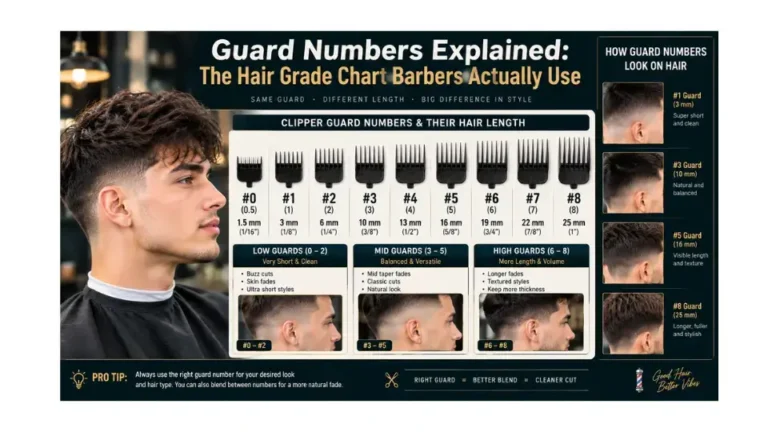
- Guard 1: about 3 mm
- Guard 2: about 6 mm
- Guard 3: about 10 mm
- Guard 4: about 13 mm
A low taper typically uses Guard 3-4 near the bottom, a mid taper Guard 2-3, and a mid fade Guard 1-2 for the closest section.
Video Guide
A side-by-side video comparison makes the height and skin-exposure differences easier to see than photos alone. Use a real barber tutorial that shows a low taper, mid taper, and mid fade cut back to back on similar hair types.This is the easiest way to see the low taper fade vs mid taper fade vs mid fade difference in motion.”
Common Mistakes to Avoid
“Most men get the wrong cut not because of the barber, but because of these avoidable mistakes when choosing between a low taper fade, mid taper fade, or mid fade.”
- Using “Taper” and “Fade” Interchangeably With Your Barber These are different techniques, and describing one while meaning the other is the most common reason for a redo.
- 2. Not Specifying the Blend Height “Low,” “mid,” and “high” all change where the transition starts — leaving this vague lets the barber decide for you.
- 3. Choosing Based on a Photo Alone The same haircut looks different on different hair textures and densities, so bring more than one reference angle.
- 4. Ignoring Face Shape A sharper mid fade can emphasize angles that a softer low taper would balance out instead.
- 5. Underestimating Maintenance A mid fade grows out faster than a low taper and needs more frequent trims to stay sharp.
How to Maintain Each Style
Maintenance frequency is one of the biggest practical differences between these three cuts,understanding this before choosing between a low taper fade, mid taper fade, or mid fade saves you extra barber visits.” since how close the blend sits to skin decides how fast it grows out and starts looking uneven. A low taper stretches the longest between visits, while a mid fade needs the most frequent touch-ups.
Low Taper Fade
Maintenance frequency is one of the biggest practical differences between these three cuts, since how close the blend sits to skin decides how fast it grows out and starts looking uneven. A low taper stretches the longest between visits, while a mid fade needs the most frequent touch-ups.
Mid Taper Fade
A mid taper needs a touch-up once the mid-side graduation starts looking uneven, which happens sooner than with a low taper but later than with a mid fade.
Mid Fade
The skin-close section on a mid fade grows out fastest and becomes visible first, so this style needs the most frequent barber visits of the three.
Heat and Product
Regardless of which you choose, avoid excessive heat styling on the top section. The American Academy of Dermatology recommends limiting high-heat styling and using low or medium settings when blow-drying. (American Academy of Dermatology)
Frequently Asked Questions
A low taper starts blending near the neckline and keeps more length, while a mid taper starts higher up the side and shows more graduation without fully exposing skin.
No. Both start at the same mid-height, but a mid fade drops closer to skin before blending back up, while a mid taper keeps the transition softer throughout.
Neither is universally better. A taper suits lower maintenance and a softer look, while a mid fade suits men who want a sharper, more defined contrast.
Yes. A low taper shows less skin and grows out more gradually, so it typically needs fewer touch-ups than a mid fade.
Yes. Ask your barber to blend the existing fade line downward on your next visit, which softens the contrast without needing to grow the whole cut out first.
About the Author
Sonia writes and maintains MidTaperFade.com, covering men’s taper fade hairstyles, hair types, styling techniques, and barber-focused haircut guides. Each guide combines hairstyle research and practical styling information to help readers choose a haircut that fits their hair and personal style.
Conclusion
A low taper fade, mid taper fade, and mid fade all come from the same family of cuts, but the blend height and how much skin shows set them apart. A low taper is the safest and lowest-maintenance choice, a mid taper is the flexible everyday option, and a mid fade delivers the sharpest, most styled contrast.
Whether you choose a low taper fade, mid taper fade, or mid fade, bring a clear reference photo and the exact name of the cut to your next appointment so your barber blends at the right height the first time.